The clay body you select determines the kiln temperature you need to achieve, the glaze chemistry that works with that clay, the shrinkage rate during drying and firing, the finished surface texture, and the structural density of the final piece. These are not aesthetic preferences — they are material properties that shape every downstream decision in your studio practice.
Three clay families cover the vast majority of production and hobby ceramics: earthenware, stoneware, and porcelain. Each has a distinct firing range, a characteristic surface quality, and a set of practical considerations that matter differently depending on your kiln, your techniques, and your finished-piece goals.
Earthenware
Earthenware is the oldest ceramic tradition and the lowest-firing of the three families. It vitrifies (reaches its maximum density) between cone 06 and cone 02, corresponding to approximately 999–1046°C. Below this range, the clay body remains porous; above it, the clay begins to deform.
The most recognisable earthenware is red terracotta — the classic orange-red body used for Mediterranean amphorae, garden pots, and Italian tableware. White earthenware bodies are also common and are used in majolica and faience traditions, where an opaque white tin glaze is applied over the bisqueware before painting and re-firing.
Because earthenware does not fully vitrify, it remains porous after firing. Functional pieces — mugs, bowls, plates — must be glazed on all food-contact surfaces to prevent liquid absorption. Unglazed earthenware absorbs water, which can harbour bacteria over time and may cause the piece to crack in freeze-thaw cycles, an important consideration for outdoor use in Canadian climates.
The practical advantage of earthenware is its low firing temperature. A standard bisque firing to cone 06 and a glaze firing to cone 04 places very modest demands on a small electric kiln. Electricity costs are lower per firing cycle, and firing times are shorter. For beginners with a compact kiln, earthenware may be the most accessible starting point.
Stoneware
Stoneware fires to full vitrification between cone 6 and cone 10 — approximately 1222 to 1285°C. At these temperatures, the clay body becomes dense, non-porous, and structurally robust. Stoneware fired to cone 10 is essentially non-absorbent even without glaze, making it the standard choice for functional dinnerware, bakeware, and food-contact ceramics.
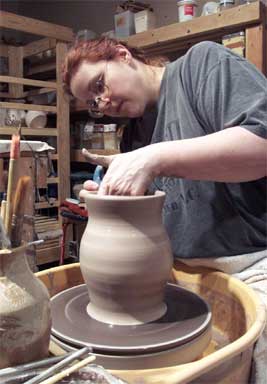
Stoneware is the most forgiving of the three clay families for wheel throwing. It has enough plasticity to pull easily, enough tooth to hold its shape during forming, and a wide enough firing range that modest temperature variations in a home kiln do not typically cause glaze defects. Most commercial stoneware bodies are formulated for cone 6 electric firing because that is the most common home studio kiln configuration in North America.
Cone 6 vs Cone 10 in a Home Studio
Cone 10 stoneware produces richer reduction atmospheres and certain glaze effects not achievable in electric kilns, but requires either a gas kiln or a specialised electric kiln rated for sustained high-temperature operation. For most Canadian home studios, cone 6 stoneware fired in a standard electric kiln is the practical default.
Stoneware bodies vary considerably in texture. Smooth white stonewares (such as Standard Ceramic's 365 White or Plainsman Clays' M340 from Alberta) throw cleanly and produce a light, near-neutral surface that shows glazes clearly. Textured stonewares with added grog or sand have more surface character and are better suited to hand-building or rustic functional forms. Speckled stonewares, which contain iron-bearing particles, produce characteristic brown speckling under clear or light-toned glazes.
Porcelain
Porcelain fires in the same range as stoneware (cone 6 to cone 10) but has a fundamentally different composition — high kaolin content, minimal iron, and often added feldspar and silica. The result is a bright white, dense, fine-textured body that becomes translucent at thin sections when fired to cone 10.
Porcelain is demanding to throw. It has less plasticity than stoneware, tears more easily during pulling, and is more sensitive to uneven wall thickness. A common beginner error is attempting porcelain before basic wheel mechanics are reliable — the clay reveals technique problems that stoneware would absorb without consequence.
For studio potters, the primary appeal of porcelain is its surface quality. Glazes appear more luminous on white porcelain than on grey or tan stoneware. Fine detail is crisper. The fired body itself, on unglazed surfaces, has a smooth, almost ivory quality that is distinctive at any glaze temperature.
Comparative Summary
The table below summarises the key variables across the three clay families:
| Property | Earthenware | Stoneware | Porcelain |
|---|---|---|---|
| Firing cone | 06–02 | 6–10 | 6–10 |
| Temperature (°C) | 999–1046 | 1222–1285 | 1222–1285 |
| Vitrification | Partial (porous) | Full at cone 10 | Full at cone 10 |
| Throwing difficulty | Moderate | Easiest | Most difficult |
| Colour after firing | Red, tan, or white | Grey, tan, buff | White to off-white |
| Typical use | Decorative, garden | Functional dinnerware | Fine functional, sculptural |
Canadian Clay Suppliers
Ceramic supply in Canada is regionalised. The following suppliers are established sources for studio clay bodies across major provinces:
- Plainsman Clays (Alberta): Canadian-mined and blended clay bodies specifically formulated for North American firing conditions. Their M-series stoneware (M340, M370) and Polar Ice porcelain are well-documented with complete technical data on their website.
- Sheffield Pottery and Tuckers Pottery Supplies (Ontario): Major distributors carrying Standard Ceramic, Laguna, and proprietary blends in bags and bulk. Serve studios across Ontario and Quebec.
- Bath Potters' Supplies (British Columbia): West Coast distributor with a range of stoneware and porcelain bodies suited to both cone 6 electric and cone 10 gas firing.
Studio Electrical Requirements
The clay body choice directly affects kiln requirements and therefore home studio electrical planning. Earthenware kilns rarely exceed 7 amps at cone 04. Stoneware and porcelain kilns firing to cone 6 or cone 10 draw substantially more current — a standard mid-size electric kiln (0.14 m³) firing to cone 6 typically requires a dedicated 240V/30A circuit.
Before purchasing a kiln, verify your home's electrical panel has available capacity for a dedicated circuit of the required amperage. This is a standard electrical job in Canada and must be completed by a licensed electrician. The Digital Fire reference database has a practical section on calculating kiln electrical requirements that is worth consulting alongside your kiln manufacturer's specifications.
Further Reading
- Wheel Throwing for Beginners — Centering, pulling walls, and trimming
- Kiln Firing Schedules Explained — Bisque, glaze, and specialty firing schedules
- Ceramics Canada — Studio and supplier directories by province
Last updated: May 4, 2026 — Blue Willow Ceramics Inc., Toronto, ON